| Mazda
RX7
I've
featured lots of hybrid Minis on this site but this is definitely
one of the most ambitious. Not only does it replace the tired old
A-series but it even does away with the pistons, con-rods etc.,
replaces front wheel drive with rear wheel drive and makes the car
mid-engined!
The
rotary engine or Wankel has been used successfully in many cars
over the years with the Mazda RX7 being one of the more popular.
As an example, Mazda's 13B rotary engine displaces
The
13B rotary engine is water and oil cooled and runs 2 spark plugs,
one coil and two injectors per rotor. The 89-91 engine achieves
an 8000 RPM redline. Rotary engines are incredibly smooth and the
13B has a flat torque curve 2000 to 5000 RPM.
The
rotary engine is very simple. There are 3 primary moving parts in
the engine. Two rotors spin around an eccentric shaft. Because of
the brilliant design, there is no need for the hardware that usually
opens and closes the intake and exhaust ports. The rotors open and
close the ports when they slide past them during the rotation. Piston
engines use complex designs to open and shut these ports. Timing
chains, cams, lifters, rocker arms, springs and valves are needed.
For
a fuller explanation of how the rotary engine works, click here.
I'll
now hand over to Regi Phillips to tell you about his RX7 powered
Mini-chop!
"This
is a 1962 Austin Mini Cooper "S". True dual tanks, and
7.5" mini disk brakes. Left hand drive from being in the states.
Has a chopped and spread top, Mazda RX7 rotary engine (165bhp stock).
Polished ports, custom header, Beefy 3rd member from Mazda station
wagon, 5 speed transmission., rounds off close to 200 BHP and that's
without bored jets, turbo-charger, inter-cooler, super-charger,
or nitrous. Any of these can be added later if desired."
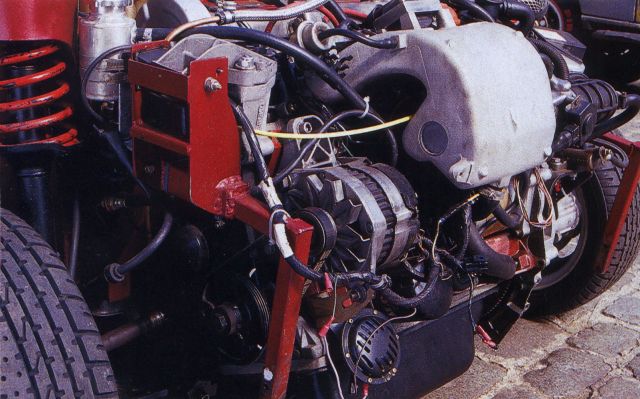
"As
you might see from the photo's, the little RX7 engine is a small
power plant when stripped down. Only 11 cubic inches without the
transmission, making for a nice fit in the early (pretty) cooper
front-end and allows for over 10,000 rpm. You do, however, need
to make a drive line cover, a hole in firewall to include 5 speed
trans., and include a rear differential, which is not needed with
the VTECs and Vauxhalls, although, you don't have push rods, overhead
cams, valves, and all of the other common revolution speed limiting
parts of the standard reciprocating engine, not to mention the space
limitation."
"At
this time I do not know how the rear wheel drive will handle, but
should handle well, considering the retained low center of gravity
and proportioned weight. It will most definitely, have different
handling characteristics then the standard front wheel drive, but
provide a more spectacular take-off from the line while lifting
the two front tires from the ground. That is if I can grab enough
traction and not twist the sub-frame. Should be a blast to try..."
"I've started the serious purchasing of parts. Spent $1500
last night and plan at least another $1200 - $1500 not including
any body work or paint. So should have good progress pictures in
the next week or two. I haven't even heard the engine run in the
last year or so, but it ran when I took it out of the donor. I can
hardly wait. I've been reading a lot on the RX7 engines and with
very simple modifications they pull off 300 bhp. i.e. header (+20
hp alone), Holly intake conversion, and some others."
Contact
Regi Phillips by email: regi.phillips@jostens.com.
Top
|

Compact size should fit under the round front
no problem.


It's going to need some sound insulation or a
real loud stereo!

Now that's a small engine!

|